|
Topics: |
|
Semen
collection for an untrained boar
An untrained boar is defined as a boar who is not used to mounting a dummy sow and routine manual collection. If you require a semen sample from a trained stud boar, request that the normal collector obtain a sample, which can be appropriately processed. Request that the collector obtains four samples
The urethra: The gel: Filtered sample of semen rich: Filtered sample of semen poor
Note a single semen sample
from an untrained boar provides only a limited assessment of the boar’s
fertility.
|
Before leaving for the
farm |
||
|
|
Field microscope, if possible. Weigh scale, 5 large polystyrene coffee cup and filter. Several plastic bags 200 ml volume. |
|
|
Request a sow in heat and remove from all boar contact for at least one hour before your collection attempt |
||
|
If the semen collection cannot be transported back to the laboratory within 1 hour of collection, prepare 0.5 litres (500g) of a commercial diluent (BTS) and place in a 1 litre plastic bag at 42ºC and place in an insulated box |
||
|
On the farm |
||
|
|
Check the temperature of the diluent – set to 35-38ºC – use the farm’s microwave. Temperature can be checked using a clean thermometer or an intrared thermometer. |
|
|
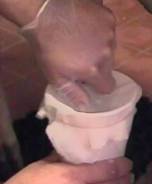
Prepare collection vessels – 5 large polystyrene coffee cups (300 ml minimum). Place the plastic bag into the coffee cup with the entrance of the bag over the edges of the cup. Place a milk filter over each coffee cup with plastic bag and hold in place by a rubber band. Label each coffee cup 1-5. Have a couple of additional plastic bags. |
||
|
|
|
|
|
Set up microscope. Warm microscope slides – at least place in breast pocket |
||
|
Set up the weigh scale |
||
|
In the barn |
||
|
|
Examine
the boar in his pen |
|
|
Pay particular attention to the size and consistency of the boar’s testes |
||
|
Watch the boar walk and note any lameness or conformation problems |
||
|
Ensure the collection area has good footing – do not collect on slats |
||

|
Prepare to collect the boar – right
handed operator |
|||
|
|
Place gloves on each hand with two gloves on the right hand |
|
|
|
Place collection vessels on one side of the pen or give to assistant |
|||
|
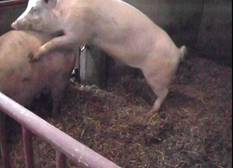
Take the sow in heat into the boar pen. |
|||
|
As the boar prepares to mount clean his underline. Watch his behaviour. |
|||
|
Empty his prepucial diverticulum while standing on the right of the boar with your double gloved right hand |
|||
|
Remove second over-glove on the right hand |
|
||
|
Watch
the boar behaviour and mounting |
|||
|
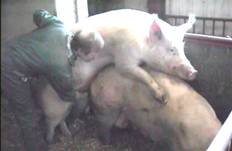
Stand on the right of the boar and sow |
|||
|
As the penis erects, with the left hand direct the penis away from the vulva |
|||
|
The boar may pull back or react to the handling of his penis |
|||
|
Take
personal care if the boar starts to dismount – do not attempt to keep him on
the sow |
|||
|
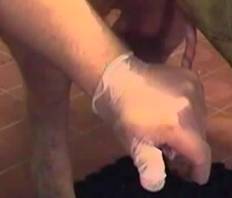
Close your hand in front of the boar penis and allow the penis to enter the closed hand |
|
||
|
As the boar thrusts through the closed hand, grip the penis with the tip of the penis just protruding beyond the closed hand. Grip the penis quite firmly. The aim is to mimic the folds of the cervix. |
|||
|
Do not
pull the penis forward |
|||
|
The boar will settle on the back of the sow |
|||
|
The penis will start to move forward and become fully erect |
|||
|
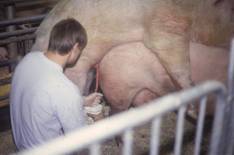
Place the first collection cup into the right hand |
|
||
|
Collect the first few spurts of ejaculate – urethral contents |
|||
|
Pass collection cup 1 to an operator |
|||
|
Place the second collection cup into the right hand |
|||
|
Collect the start of the collection, concentrating on the sperm rich portion |
|||
|
Pass collection cup 2 to an operator – testical, vesicular and prostrate |
|||
|
Place the third collection cup into the right hand |
|||
|
Concentrate on collecting the sperm poor portion |
|||
|
Pass collection cup 3 to an operator – vesicular and prostrate |
|||
|
Place the fourth collection cup into the right hand |
|||
|
Collect any remaining ejaculate |
|||
|
Ensure that you continue collecting the boar until ejaculation has finished |
|||
|
Allow the boar to dismount |
|||
|
Place the gel (in your collection hand) into a plastic bag - gel |
|||
|
Label all of your samples |
|||
|
(Collection cup 5 was for emergencies) |
|||
|
Processing samples |
|||
|
On farm |
|||
|
|
Smell each of the ejaculates – there should be no smell |
||
|
Weigh the combined collections from 2, 3 and 4 samples |
|||
|
Note the colour of the ejaculates – off white is normal |
|||
|
If the microscope is set up, place a drop of semen rich sample on to a warmed slide and observe at x40 and look at the motion of the semen sample |
|||
|
Add diluent to samples 2,3 and 4 – at a volume of at least 3x the sample. Note the dilution rate using the weight scale. 1 ml = 1 g. |
|||
|
In the lab |
|||
|
|
Carry out morphological examination on the sperm rich portion – using Nigrosin/Eosin stains. |
||
|
A semen quantitative analysis is carried out using a haemocytometer – use combined samples of 2, 3 and 4. Note the dilution rate. |
|||
|
Examine each sample for presence of inflammatory cells – make a smear and stain using Diff Quick for example. |
|||
|
Carry out a bacteriological examination on the samples – note semen is not sterile |
|||
|
Record all the results |
|||
|
The aim of collecting the various fractions is to attempt to locate the presence of any inflammatory process. |
|||
|
Review of the boar’s
reproductive anatomy |
|||
|
|
|
||
|
The bulbourethral gland produces the gel The vesicular glands provides fructose and sugars The prostrate (situated ventral to the vesicular glands) provides the fluids The testes produce the sperm |
|||