Caesarian
Section
|
|
|
|
|
Drawing
showing the position of the incision to gain access to the abdomen. This access is used to minimise the amount
of subcutaneous fat. In addition the
three abdominal muscle layers have merged into one layer. |
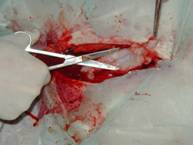
Incise
through the skin and muscle layer to the peritoneal layer. Penetrate the peritoneal layer with a
scapel blade and then using scissors extend the incision. |
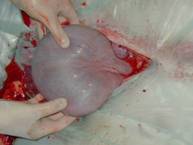
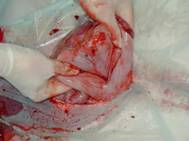
The
uterus is normally very obvious within the abdomen. Remove part of a uterine horn with a piglet
inside. |
|
|
|
|
|
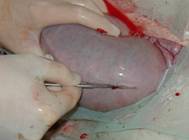
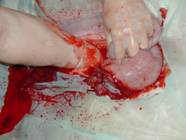
Incise
the uterus over the back of the piglet. Take care not to incise into the
piglet. |
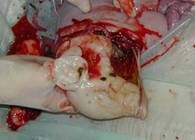
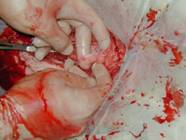
Remove
the piglet and pass to an assistant to encourage respiration. Clear the airways and if necessary use a
respiratory stimulant. |
Hold
the edges of the incised uterus. |
|
|
|
|
|
Remove
adjacent piglets, higher and lower from the incision. Do not attempt to remove all the piglets
through the one hole. Three piglets per
uterine incision is adequate. |
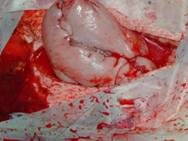
Close
the uterine incision using an inverted Lambert stitch and absorbable suture
such as PDSII or catgut. |
Close
the peritoneum cavity with Vicryl or PDSII.
Close the muscle, subcutaneous and skin as normal |
Surgical issues
|
Fat blindness |
|