E. coli General Notes
|
Name |
|||||
|
Agent |
Bacteria
belonging to the Enterobacteriacae. Other
members include salmonella and klebsiella |
||||
|
Diseases |
0-3 days of age associated
with toxins |
Sudden
death, often with few clinical signs.
Those that survive can be very stunted with a gaunt hair staring
coat. Reddening of the skin of the perianal area and under-side of tail may be present. |
|||
|
|
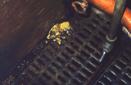
Loose
to watery brown,
white or cream coloured diarrhoea.
Reduced gain and loss of weight, depression and loss of appetite,
rough hair coat, sunken eyes, unthrifty appearance with ribs and backbone
highly visible. One or two days of
scours pre-weaning can add 5 days to finishing. |
||||
|
|
Loose
to watery brown,
white or cream coloured diarrhoea.
Reduced gain and loss of weight, depression and loss of appetite,
rough hair coat, sunken eyes, red streaking or soreness in the anal region,
unthrifty appearance with ribs and backbone highly visible. One or two days of diarrhoea
post-weaning can add 5 days to finishing. |
||||
|
|
Toxins
from E. coli in the stomach and
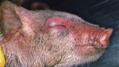
intestines in the post-weaning period result in oedema throughout the animal
which presents with swollen eyelids and death and ill thrift. Some neurological signs can be seen. Presenting signs seen most commonly second
week after weaning. |
||||
|
|
Immediately
after farrowing, reddening hard and hot mammary gland. Most E.
coli mastitis are actually from toxins from the
intestines rather than mammary gland. Toxin works against the Prolactin hormone |
||||
|
|
Many
sows have cystitis after farrowing or service associated with poor urination
or hygiene. If the infection is complicated
with other bacteria, such as Actinobaculum suis from the boar's prepuce, the
kidneys can become infected as well (pyelonephritis). |
||||
|
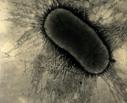
The
organism |
The
bacteria is the large oval in the centre. Surrounding the bacteria are 'hairs' called
fimbriae which contain the adhesion factors which
the bacteria use to stick to the host cells.
Flagellae are long and used to move the
bacteria. The example shown has no
flagella. |
|
|||
|
Classification |
By cell wall |
O antigens O147 for instance |
|||
|
Fimbriae |
F antigens (use to be K antigens) F1, F4 (K88), F5(K99), F18 (F107), F6 (987P), F41,
FP |
||||
|
Flagellae |
H antigens (not
used to classify E. coli) |
||||
|
Therefore the E.
coli can be given a code which is useful to indicate its likely role in
the disease. For instance Diarrhoea is often associated with O147, F4, F5 this is E.
coli Abbotstown Bowel Oedema is associated with F18 fimbriae. |
|||||

|
Recognising the code is important in the selection of
the correct vaccine |
||
|
Toxins |
E. coli can produce a number of toxins |
|
|
Exotoxins |
LT and ST toxins are actively produced by some
strains. These are important in
causing scour. Shigela-like toxin type II variant
(SLT-IIe), Stx2e, verotoxin
oedema disease principle act on the wall of the
small arteries resulting in oedema. Enteroaggregative (EAST1) toxin. |
|
|
Endotoxins |
From breakdown products from the cell wall which plays a
role in mastitis as it acts against Prolactin (the
hormone which releases milk) and in urinary tract diseases. Major cell wall toxin called Lipid A. |
|
Diagnosis
|
||
|
Laboratory cultures.
The collection of the sample is critical and requires a rectal swab from
a recently infected (ideally untreated piglet) or if the problem is severe
the submission of live recently ill pigs provides the best material. |
||
|
Checking for and ruling out viral or parasitic causes |
||
|
Examine intestinal pH, when at 8 or above suggestive of E. coli |
||
|
Check herd history, past treatments, feed medication,
incidence of scour |
||
|
Determine age of affected pigs, disinfectants used, pig
flow and environmental effects |
||
|
Treatment
and control |
||
|
Hygiene |
Adequate pressure washing. Utilise
All-in/All-out. Sick animals are not
put back through the system. |
|
|
Pre-weaning scour |
Check for draughts and colostrum intake. |
|
|
Post-weaning scour |
Check mixing routines, draughts and temperature variations/cooling
curves. |
|
|
Antibiotics |
Ideally after the organism has been grown in the lab. The
E. coli is grown and then tested against a range of antibiotics to
determine which will provide the best cure |
|
|
Vaccines |
To the sow and via colostrum to the piglet. Note vaccine storage and administration
have got to follow prescribed protocols.
Water vaccines are available for bowel oedema |
|
|
Farming Practices |
To reduce stressors on the pig, particularly in
neonate. Many cases of 'scour'
associated with E. coli will
respond poorly to antibiotics as the real cause are
draughts. Examine each area in detail
and remove as many of the stress factors as possible. Even
a barely perceptible draught can result in a wind chill 3•C below thermometer
readings. A draught can be considered to be a chilling “wind” of
only 0.2 m/s Environmental
examination |
|
|
Colostrum |
The vital ingredient to survival pre-weaning. Feed back of
weaner faeces is given to sows and gilts to ensure that her colostrum is
adequate |
|
|
Feeding routines |
Ensure good quality feed is being used as creep. Check feed quality actually being fed not
just in the bag. Check feed for
allergic factors, i.e. plant proteins being fed too early. In pre- and post-weaners provide small amounts
of fresh feed several times a day, this helps to minimise digestive
stress |
|
|
Dry sow feeding |
Effective and disciplined feeding regimes are required to
reduce udder oedema, mastitis and constipation |
|
|
Adequate Water |
The lack of water is a major stress factor on the pig at
all ages. However, insufficient
marginal water supplies play a major role in the cause of cystitis and kidney
disease in the pig |
|
|
Genetics |
With bowel oedema in particular, only pigs which have the
correct genes to allow the F18 fimbriae to attach will
result in the disease. Changing the genetics may result in removal of the
disease from the farm. There are F4
negative pigs, but these have not been exploited commercially. F18 negative pigs are commercially
available. Do not select from sows/gilts who
have any history of diarrhoea in the farrowing
house. Over time this will select away
from susceptibility towards E. coli
types especially F4. |
|
|
Zoonotic implications |
||
|
E. coli is a potential pathogen in humans. However, the more
significant strain E. coli VTEC 0157 is only very rarely found – less than 0.3% of
carcases in a UK study. |
||