PRRSv
outbreak control in a naive herd
|
|
Abortion
storm – particularly North American strains |
|
|
Rolling
inappetance in gestation sows |
||
|
Early
farrowing/late abortions – 112 days gestation |
||
|
Sudden
deterioration in health of piglets in farrowing house |
||
|
Treatment |
||
|
General |
Acetylsalicylic acid (aspirin)
20mg/kg in the water supply |
|
|
Vaccinate whole adult
population with a commercial live vaccine |
||
|
Feed back programme – need to
vaccinate with the current (new) farm
strain. Materials that might be
useful: |
||
|
|
Faeces
from aborted sows |
|
|
Poor
piglets less than 10 days of age – kill and macerate include stillborn and
mummified piglets |
||
|
Tonsilar
scrape from aborted sows |
||
|
Previously frozen serum (if available) to make an
autogenous vaccine if used previously.
Note this may be a new strain. |
||
|
Note: This may increase chance of further abortions. However, these susceptible sows would have
aborted when they became infected anyway.
By the combination of a reduced infective dose and treatments the
abortions should be reduced |
||
|
10 days after initial
vaccination/feedback etc revaccinate whole herd with a dead PRRSv
vaccine. This reduces the shedding
time of PRRSv from infected animals |
||
|
Additional considerations |
||
|
Breeding Gestation |
Increase the number of sows
bred |
|
|
Increase number of doses of
semen – from 2 to 3 or increase semen concentration in semen dose |
||
|
Stop culling of sows wherever
possible |
||
|
Raise dry sow temperature to
21C |
||
|
Avoid large temperature
change: temperature drops at night or
peaks during day |
||
|
Increase feed intake by 0.25 to
0.5 kg a day for next four weeks |
||
|
Individual sows may require
individual antimicrobial treatments and flunixin (2.2mg/kg) or equivalent |
||
|
Farrowing |
Raise farrowing house
temperature to 22C |
|
|
Provide more straw, shavings or
paper if possible |
||
|
Provide extra heat for
surviving piglets |
||
|
Farm |
Ensure pig flow is correct –
vital to stop over and understocking |
|
|
Enhance cleaning to reduce
pathogen load around the farm |
||
|
Intermediate
Control |
||
|
|
Feed-back, tonsilar swab
vaccination to all new gilts on entrance to the farm |
|
|
Administer dead vaccine 10 days
after entrance |
||
|
Biosecurity review all
practices and enhance loop holes |
||
|
Note AI source, live genetic
source, locality as primary sources |
||
|
Investigation |
|
|
Initial |
Bleed sows and look for PRRSv
RNA by PCR |
|
|
Bleed sows for antibodies but
this may take 21 days post-infection |
|
Sequence recovered PRRSv to
help determine source – compare with previous strains on the farm if
previously positive |
|
|
Bleed any gilts in isolation by
PCR and antibody levels |
|
|
Examine AI for PRRSv by PCR |
|
|
Long
term measures |
|
|
|
Assuming that the biosecurity
breach is controllable |
|
Reassess situation, introduce gilts
and close farm for 6 months to restore PRRSv negative status - link |
|
|
There is only one control
measure for PRRSv – negative status but must be more than 1.5 km from another
pig farm and have excellent biosecurity |
|
|
Adopt on-farm AI only or frozen
semen for new genetics |
|
Major clinical signs of a PRRSv break in a naïve herd
|
|
|
|
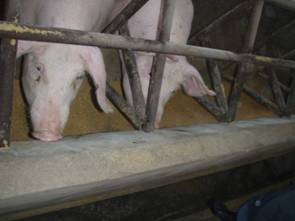
Rolling inappetance in
sows and gilts |
Abortion storms |
|
|
|
|
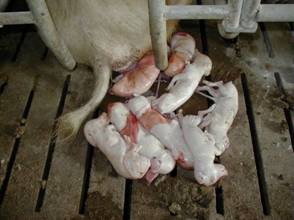
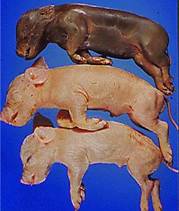
Early farrowing with late
mummified piglets |
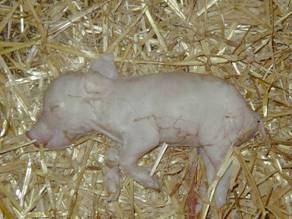
Weak piglets in the farrowing
house – increase in diarrhoea with E.
coli and Rotavirus |