Pleurisy
Pleurisy is a common result of pathogens/ foreign material gaining access to the pleural cavity. Organism are moved to the pleural cavity as part of the respiratory systems defence mechanisms.
It is not possible to differentiate the cause of the pleurisy by the gross examination of the carcase. The lesion is a healing scar tissue and generally sterile.
Pleurisy can be present for several months before resolution.
Therefore, pleurisy seen in the slaughterhouse may have occurred at any time in the last 5 months – thus the entire life of the pig!
|
Slaughterhouse examination |
||
|
|
|
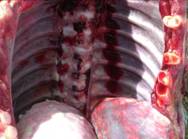
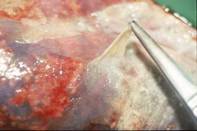
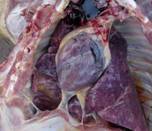
Pleurisy on the surface of the lung or attached to
the carcase rib cage |
|
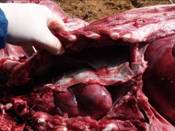
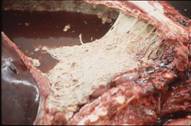
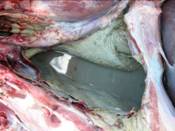
Postmortem findings associated with a variety of
pleurisy causing pathogens |
||
|
|
|
|
|
|
|
|
|
Arcanobacterium pyogenes |
||
|
|
|
Pleurisy can
also be associated with other pathogens for example: Escherichia coli Swine Influenza – localized areas |
|
Septic
pleuritis – pseudomonas – from a puncture wound |
|
|




|
Causes |
|||
|
|
|
|
|
|
|
|
|
|
|
Treatment and control |
|||
|
|
Review causes of vice |
||
|
|
Review the flooring |
||
|
|
Review post-weaning
housing and stress factors – especially air and water supplies |
||
|
|
Control Glässer’s
Disease |
||
|
|
Control
clinical Actinobacillus pleuropneumonia. Majority of farms are positive to at least
one serotype of APP – but do not have any significant pleurisy issue |
||
|
|
|
|
|
|
|
|
|
|
|
Rough floors –
note new floors can be particularly problematic |
Remove any
sharp objects within pig height |
||