|
Pre-weaning behavior:
It is important to try and mimic as much as
possible the pig's requirements pre-weaning in that immediate
post weaning period. |
|
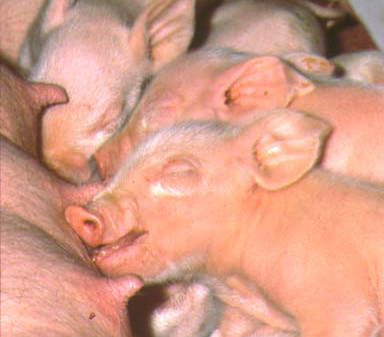
Each piglet has:
 |
-
A drinker each
-
A feeder each
-
Minimal competition at eating/drinking
-
Eat and drink warm liquid feed
-
Eat and drink as a group
-
Eat and drink once every 1-2 hours. Sows in
crates feed once every hour, those loose housed by 24 days
feed once every 2 hours, the weaning process has started
-
Mother determines the time to eat ? the
piglet does not. It is not an instinctive drinker, it is
behaviour driven
-
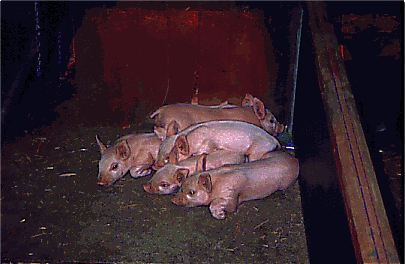
Sleep as a group
-
Clearly defined sleeping area
-
The piglet may not even recognize itself as
an individual, only recognize the group
|
| |
- How many of these normal behaviors are
catered for after weaning?
|
|
Basic
management required for the weaner:
(Note that the pig would normally be weaned over
a 12 week period) |
|
Water:
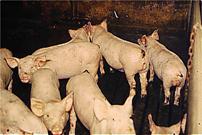 |
- It is essential to train the newly weaned
pigs where their water supply is positioned
- The water supply needs to provide more than
500 mls/min. Less than this flow, pigs will not spend more
time to get their water supply. In the first week post-weaning
there is no variation in water intake over the 24 hours,
unlike after a week where water consumption is more during the
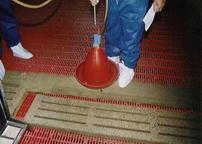
day and becomes associated with feed. Turkey drinkers provide
a surface of water and allow pigs to drink as a group. Wasted
water can be minimized if the drinker is suitably balanced.
Turkey drinkers can be used for hospital pigs as they are
easier to clean than a cube drinker. However, sufficient space
is required for turkey drinkers, they require some big pen
concepts. Insufficient water supply leads to fighting and
ultimately variation in the group. Consider adding a sweetener
to the water if it encourages intake.
|
|
Air
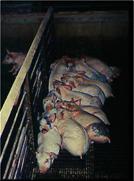 |
- Assess whether the pigs are comfortable by
looking at the pigs when they are asleep and look where and
how they are lying. It is essential to provide a sleeping area
which is draught free and with an initial air temperature of
30oC either through adequate artificial heating, heated floors
or straw/bedding. Avoid gases moving from the slurry pits into
the pig?s building. Enter pens quietly to assess weaner lying
patterns. Noisy stock people will miss clear evidence of
draughts.
- Keep the lights on for the first 3 days so
the pigs can find the equipment, before weaning they probably
had 24 hours of light.
|
|
Floor
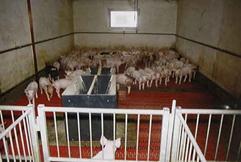
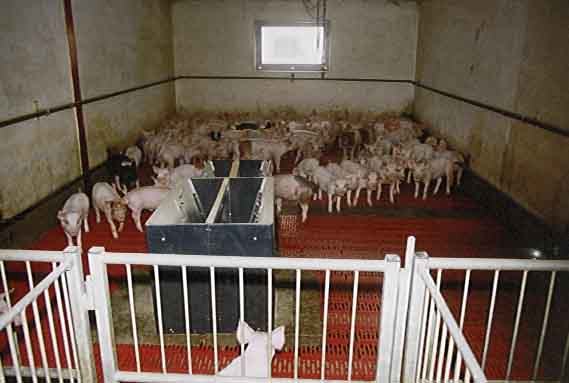
A big pen with a draught free
sleeping area at the back of the pen
|
- The floor needs to be non abrasive. Having
steps to feeders can cause damage to the knees and legs,
particularly important in future breeding stock. The stocking
rate is important and you need to avoid both under and over
stocking. This can only be achieved through good pig flow.
Pigs to 20 kg require 0.2 m2, to 30 kg they require 0.3 m2.
All-in/all-out, adequate pressure washing/disinfecting is
essential to prevent cross over of infection from one group to
the next. The use of lime washing where possible is to be
encouraged.
|
|
Stock |
- To manage the pigs adequately it is
essential to maximize the weaning weight. Aim to cope with the
smaller weaned pigs, one possibility is by streaming these
pigs sideways. Providing more ideal environments and possibly
medication. These pigs should be provided with wet creep feed
for longer than the rest of the group. Moving 10% of the pigs
sideways, giving them good hospital accommodation and possibly
re-introduce them back into the main group but at 18 kg + even
if these pigs are a week older. Never introduce compromised
pigs back into newly weaned pigs at 7 kg, the immune system of
the 7 kg pigs is grossly inadequate to cope.
|
Feed:
Feed has several aspects in the 1st five days |
|
Palatability
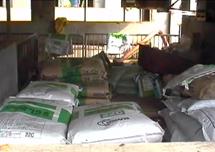 |
Feed at this stage is a high quality, high
cost milk diet. It is essential not to store the feed at above
18oC ? which exists in all weaner houses. Ensure the feed bag
is closed at all times. The feed will sour quickly. |
|
Hygiene
of feed |
Ensure feed is properly stored. Protect the
feed from infestation, for example store off the ground.
Rodent contamination is a source of Salmonellosis |
|
Number of times to feed |
Prior to weaning pigs eat every 1-2 hours
(12-24 times a day) depending on the management system. The
mother determines feed times, the piglet does not, therefore,
feed little and often. On several farms the newly weaned pigs
are fed 8 x a day and even this is compromised but fits into a
working day. This is continued for 3 to 4 days post-weaning.
Ensure all weaners eat. While this seems extreme, if the feed
intake in the first week can be optimized this can be worth 10
days to finish and the reduction in treatments easily
compensates for the extra labor effort. This can be reduced
over the 1st week to 2-3 times a day feeding. |
|
Type of feed |
The piglet thrives on liquid/porridge type
feed. Provide a creep/water mix and provide for the 1st few
days. The aim is to get the pigs to ?beg? for the feed, this
makes identification of any poor intake pig much easier, but
does require a feeding system where all pigs can eat together.
Any weaner that misses two eating episodes should be taken to
the trough and force fed/watered. The provision of clean,
warmed acidified feed helps to control post-weaning diarrhea. |
|
Type of feeder
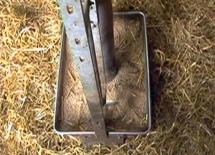 |
It is vitally important in the first week
that all pigs can eat together and therefore a trough is
required. The neck space for a pig at 7-10 kg is 70-100 mm.
The turkey drinker can help as it can be used as a wet feeder
in the first 3 days. The use of long feed troughs can provide
sufficient space. Once the pigs are eating we can then
increase the dry feeding through a trough. The feeder shown is
for illustration only. |
|
Minimize waste
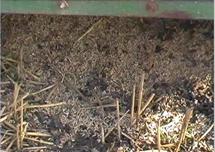 |
- Review feeder usage to minimize waste.
Avoid floor feeding if possible unless you can justify this on
economic grounds.
- The picture shows feed that the weaners
have wasted and has fallen through the slats. This only helps
to encourage rats, birds and flies to the farm
|