Tropilaelaps
|
Causal agent |
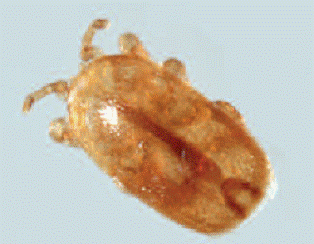
Tropilaelaps clareae and T. koenigerum -
Parasitic mites Mites are 1 long x
0.6mm wide. T. koenigerum is slightly smaller. |
||||||
|
Age group |
|||||||
|
Egg |
Larvae |
Pupae |
Adult - worker |
Drone |
Queen |
||
|
No |
No |
Yes (Drone+) |
Yes |
Yes |
Yes |
||
|
Clinical signs |
|||||||
|
|
The mites natural
host is Apis dorsata (Asian honey
bee) |
||||||
|
|
|||||||
|
Infestation of the
hive may lead to collapse and absconding. |
|||||||
|
|
|
||||||
|
Infectivity |
|||||||
|
|
The adult female mite
infests a larvae as the larvae is about to be capped. The larvae pupates
and the mite feeds off the pupae haemolymph.
The mite lays eggs. The first
egg hatches is a male and the subsequent mites are female. The male mates with his sisters. The life cycle is must faster than in
Varroa rate of 25:1. The adult female
mite cannot feed off the host. Female
mites die within 2 days without brood. |
||||||
|
Transmission |
|||||||
|
|
Horizontal - Drifting
and robbing. Concentration of hives in
an area. Can live on other bees. Vertical –through the
brood The mite can live on
a number of Apis species – A. dorsata
(Asian Honey Bee); and also A.
laboriosa, A. ceranae and A. florea (other Asian species) |
||||||
|
Post-mortem
Lesions |
||
|
|
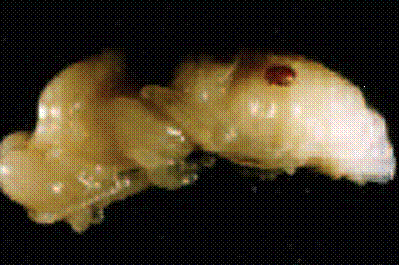
Presence of mite. |
|
|
Diagnosis |
||
|
|
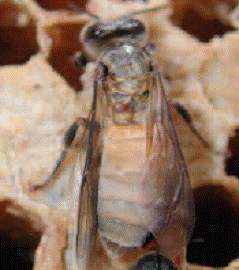
Mite seen on the bee |
|
|
Note the difference
between Tropilaelaps and Varroa – Tropilaelaps is smaller and elongated. |
||
|
Monitoring mites with
a screened bottom board with a sticky surface – spray on cooking oil for
example. |
||
|
Take 500ml of car
windscreen washer fluid (alcohol).
Shake around 500 bees into the solution (one frame). Shake the fluid and bees. The bees are killed in the fluid. Count the mites which appear. The mites will generally float to the top. |
||
|
Ether roll – Collect
200-300 bees into a jar and anaesthetise with ether – from an car store used
in air to start engines. Use 1-2
second blast. Roll jar for 10 seconds,
mites dislodge and adhere to side of jar.
Remaining bees can be spread on a white paper to see additional mites
if required. |
||
|
Treatment |
||
|
|
None of the treatments achieve elimination only control Mite can be controlled without brood – cold climates may limit spread of mite. |
|
|
Chemical |
Tau-Fluvalinate (Apistan) or Flumethrin (Bayvoral) both synthetic pyrethroids Start treatment when sticky boards reveal over 200 mites after 3 days exposure. The strips are normally applied for up to 6 weeks Note these chemicals can build up in the honey and eventually will affect the bees. 2 years of application has affected queen bee fertility. These products may be more useful in the Autumn. |
|
|
Apiguard – Thymol. Once the temperature is above 15°C Thymol products can be used. Use two applications 10 to 15 days apart. |
||
|
Api Life Var – Thymol, eucalyptus oil, menthol and camphor. This is used two 14 days apart. |
||
|
|
|
Organophosphates - Coumaphos (Checkmite+).The checkmite+ strip hangs down between frames in the broodnest so bees can walk on it and pick up minute amounts of the active ingredient. Do not put the strip on the bottom board, tops of frames. |
|
Be careful when medicating with products that may affect honey quality |
||
|
Organic acids treatments are being developed |
||
|
Oxalic acid – This is not authorised in the UK. Oxalic acid can kill brood and therefore has to be used in brood-less colonies – in the wintertime. Mix 6% of oxalic acid with 30% sugar solution and apply by the trickling method. Note the products have to be used fresh and breakdown products can be toxic to the bees –hydroxymethylfurfuraldehyde. |
||
|
Sucrose octanoaten – a sugar and soap solution. Need to repeat 3 times to kill mite eggs. |
||
|
Formic acid can be used on the bottom boards. This can be useful to control tracheal mite. Administer 30 mls every week for 3 to 5 applications in the spring. Then again in June. Air temperature needs to be above 22°C but below 30°C |
||
|
Mechanical |
Eliminate brood for more than 3 days will eliminate mites |
|
|
Drone brood sacrifice – drone trapping |
||
|
Queen trapping |
||
|
Artificial swarm technique |
||
|
Shook swarm technique |
||
|
Screening bottom boards – sticky boards. With a moderate to heavy mite infestation the sticky board will have 150 to 500 mites stuck to it. |
||
|
Others |
Reducing drifting |
|
|
Common differentials |
||
|
|
Varroa –much bigger |
|
|
Zoonosis |
None |
|
Life cycle of Tropilaelaps

From this a generation
time can be calculated:
|
Time |
Event |
Time |
Event |
7.5 days queen would
emerge |
|
2 days |
Male laid |
8 days |
Male matures |
|
|
3 days |
Female laid |
9 days |
Females matures |
|
|
4 days |
Female laid |
10 days |
Females matures |
|
|
5 days |
Female laid |
11 days |
Females matures |
|
|
6 days |
Female laid |
12 days |
Females matures |
12 days worker would
emerge |
|
7 days |
Female laid |
13 days |
Females matures |
|
|
8 days |
Female laid |
14 days |
Females matures |
|
|
9 days |
Female laid |
15 days |
Females matures |
14.5 days drone would
emerge |
|
10 days |
Female laid |
Female not mature in
time to be mated |
||
This explains why the
queen larvae are rarely infested with Tropilaelap mites, but the longer
pupation of the drone allows for large number of mites to reach maturity and
fertility, but the effect is less than noticed with Varroa.
On average, the female
mite produces 4 new female (as well as herself) for each worker larvae infested
and 7 female mites for each drone larvae infested.
There can be many
different female mites infesting the same larvae at the same time- 14 have been
recorded.
It is even possible for
new females to produce a mated female offspring before drone mature.