Biosecurity for Swine Units –
keeping new strains of Porcine Reproductive and Respiratory Syndrome out.
This paper will examine some of the broader issues governing biosecurity on swine units with a special emphasis on the spread of Porcine Reproductive and Respiratory Syndrome Virus (PRRSV).
PRRSV has been the scourge of the global swine industry for over the last decade. Few countries and farms have escaped its ravages. Now a new threat is emerging with the progressive mutation of PRRSV, typical of an RNA Arteriovirus, resulting in new strains, which are not protected by previous exposure to current on-farm strains and the nightmare of recombination - potentially creating an even more virulent strain. In addition, multiple strains can exist on the same farm, without recombination, and when a critical mass of uninfected population emerges through replacement a ‘new’ repeat outbreak occurs.
It may seem obvious that a PRRSV negative unit needs to practice excellent biosecurity. However, PRRSV positive farms cannot afford to adopt any less of a program. It could be argued that a PRRSV –ve unit is likely to only break with one new strain, a PRRSV +ve unit could break with new and multiple recombination strains. It is with this background that this paper briefly explores practical biosecurity on pig’s farms.
1. Threats to swine unit
Threats to a Swine
Unit
They are in order of general importance, but the order
can change depending on many circumstances
|
Potential
threat |
Real or not for PRRSV |
||
|
|
Demonstrated |
Suspected |
No |
|
Other pigs – gilts and boars |
+ |
|
|
|
Pork products (ham, salami, sausage, pizza) |
|
+ |
|
|
Rendering (placement of dead pig disposal area) |
+ |
|
|
|
Transportation systems |
|
+ |
|
|
Locality of neighbouring pig units |
+ |
|
|
|
Presence of a major road |
+ |
|
|
|
Purchased second hand equipment |
|
+ |
|
|
Clothing from another unit |
|
+ |
|
|
Birds, Rodents, Cats, Dogs, Flies |
+ |
|
|
|
Feed and water |
|
+ |
|
|
Bedding and straw (note source of manure for straw) |
|
|
+ |
|
Staff owing their own pigs |
|
+ |
|
|
Staff visiting pig markets, shows and slaughterhouses |
|
+ |
|
|
Vets and other advisors (excluding clothing etc) |
|
+ |
|
|
Visitors (note electricity and gas service people) – no pig contact |
|
|
+ |
|
New utensils |
|
|
+ |
2. Detail of biosecurity to reduce threats to the unit
a. Animal Introduction
The introduction of animals, (gilts, boars, semen, embryos, meat, and wildlife) are the major method of disease spread and has to be given the greatest attention.
An isolation facility is essential on all units. Ideally it would be 50 metres away from other stock. However, with PRRSv control it has been demonstrated that the virus can transmit over 150 metres. A distance of over 150 metres is clearly impossible on several units in high pig dense areas. I have suggested 500 metres between main unit and isolation when cleaning units up by early weaning which has been successful for the last 10 years. However, when the UK was first infected with PRRSv, it appeared to spread over 2 km between units, but there was massive infection in the locality at the time.
An introduction program should be written for gilts and boars and strictly implemented. An example program is illustrated below:
Animal Introduction Program
|
On arrival |
|
|
First two weeks |
|
|
1 |
Ensure animals are separate from native pigs for two weeks |
|
2 |
Ideally separate by 50 meters |
|
3 |
Attempt to acclimatise the animals to the new environment. Initially attempt to simulate the original environment. Make changes gradually |
|
4 |
Pay particular attention to: The cooling systems and water supply If possible have bagged feed from original farm or make attempts to match original feed. If pigs come from a straw based system, utilise straw or solid flooring before introducing to slatted systems |
|
5 |
The animals may require antimicrobial or additional vaccine therapy following introduction. To introduce PRRSv negative gilts/boar into a PRRSv positive farm serious attempts must be made to introduce the gilts/boar to the circulating farm PRRSV viruses – tonsilar scrapes and serum have been successful. |
|
2nd to 4th week post introduction |
|
|
1 |
Introduce cull adult or grow/finish stock to the new arrivals. PRRSv is not effectively transmitted by cull animals. Ideally on farrow to finish farms, weaners about 25 kg are generally excreting the virus. |
|
2 |
Change over the environment to match local conditions |
|
3 |
It may be necessary to medicate the pigs depending on how they respond to the new diseases |
|
4th to 8th weeks post introduction |
|
|
|
Remove grow/finish animals to allow the new pigs time to recover from any illness. |
|
Introduce into the herd following veterinary approval of the health. Contact source farm for disease update prior to entry. |
|
|
Record all signs of illness over the 8 week period |
|
Artificial insemination is a very effective method of enhancing genetic transfer at minimal risk. Unfortunately, PRRSv is easily transmitted through semen during the brief viraemic phase of the boar. During this phase the boar(s) may have no clinical signs. While there are many attempts to protect farms through the use of PCR technology, the technology is not proven enough to adequately take the risk. On-farm AI collection is the only way to reduce/control this risk, the farm AI boars go through the same vigorous regime as incoming gilts.
If the incoming gilts are negative, I would not suggest statistical method of detection, all incoming animals should be blood tested and examined. In my experience, while 0.4 ELISA S/P is the accepted cut off from PRRSv positive to negative status, the negative farms I look after report 0.0.to 0.2, it is disappointing that farms with 0.39 are classified as negative when the PCR results come back negative. The industry needs to adopt much tighter controls. Many ‘breakdowns’ were never truly negative.
b. Basic Unit security
A set of rules regarding entry to the unit for animals and people is required. The rules illustrated would be for a high health unit. Your own rules may be more or less than these.
Advanced Unit Security
|
Basic Design |
|
|
1 |
The unit must be surrounded by a complete fence |
|
2 |
The fence should be 2.5 metres high and 0.5 metres deep to stop pigs and other mammals entering and leaving the unit |
|
3 |
A car park should be sited away from the unit and appropriately marked |
|
4 |
All entrances through the fence must be locked |
|
6 |
All personal items including personal clothing, watches, cigarette lighters etc. must remain outside the entrance area |
|
7 |
Spectacles, cameras and other visitor equipment must be inspected by a member of staff before being allowed onto the unit |
|
8 |
All meters (electrical, gas and water) must be situated off-farm and placed in a locked area |
|
9 |
The farm manager's office should be situated near the entrance |
|
10 |
A horn switch should be placed by the car park to attract staff attention to visitors. |
|
11 |
None of the staff should own or come into contact with other pigs |
|
12 |
No staff should visit animal markets, pig shows or slaughterhouses |
|
13 |
No unauthorised pigs, pig products or pig faecal material must be allowed onto the farm |
|
14 |
Unit rules regarding last pig contact must be strictly adhered too |
|
15 |
All entry and exit points should be well lit, ideally with proximity sensors |
|
The following entrances/exits are permitted |
|
|
1 |
Entrance via a locked door into staff shower facility |
|
2 |
Entrance via a locked door into a visitor shower facility |
|
3 |
Connector to the feed bins which pass through the fence |
|
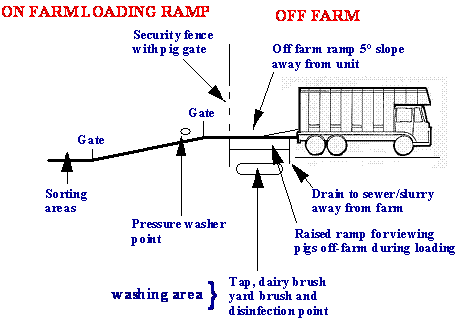
4 |
Exit via a raised ramp for livestock |
|
5 |
Exit for dead animal disposal through a locked gate |
|
6 |
The straw barn has an entrance from off-farm and an entrance on-farm. Both should be kept locked. Staff are not allowed to leave the farm through the straw barn |
|
7 |
Slurry disposal through underground pipe to slurry store off-farm |
Animal
Entry and exit rules
Unit security
Entry and Exit
Procedures for Livestock
|
Loading ramp rules |
|
|
1 |
Trucks must have no pigs on board, must be clean, washed and disinfected |
|
2 |
The off-farm disinfectant/washing area (see above) must be prepared prior to each loading by the unit staff, (wearing off-unit clothing) and then they must re-enter the farm |
|
3 |
The truck driver must inform a member of staff using the horn upon arrival |
|
4 |
The truck drivers must wash their hands and wear the over-boots provided and dip the boots in the disinfectant provided |
|
5 |
The truck driver's name and vehicle number should be logged in the animal movement book |
|
6 |
Farm staff must not cross the security fence line or the loading ramp |
|
7 |
The loading ramp area must be thoroughly cleaned after loading each batch of pigs |
|
8 |
The truck driver must not enter the unit under the security fencing onto the on-farm ramp to assist the loading |
|
9 |
All entry and exit points should be well lit, ideally with proximity sensors |
|
10 |
The sorting area and on-farm loading area must be thoroughly cleaned and disinfected once the pigs have arrived or left |
Disposal
of dead stock
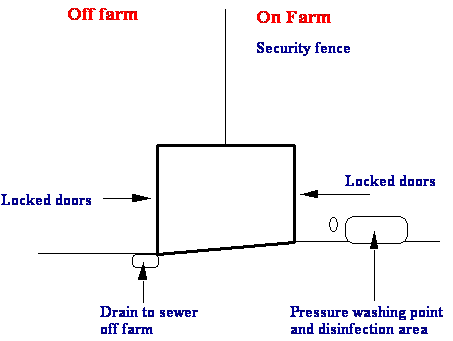
The collection of dead stock by rendering trucks can prove to be a serious risk to a farm, in particular negative farms. Ideally, composting of all dead stock should be encouraged.
To ensure that fallen stock is picked up safely an advice sheet is
required. A suggested operating sheet is
provided
Disposal of Dead Pigs
|
1 |
When a dead animal is identified this should be recorded |
|
2 |
The farm manager should decide if a post-mortem examination is required |
|
3 |
The animal should be removed from the house as soon as possible |
|
4 |
The animal should be moved to the perimeter fence dead area |
|
5 |
The dead pig area should be designed as below |
|
|
|
|
6 |
Once the dead pigs are removed by the rendering company the dead box should be pressure washed and disinfected |
|
7 |
The dead box should be emptied at least once a week, twice in the summer months |
|
8 |
Cover cuts and abrasions when handling sick or dead pigs |
|
9 |
Always wash your hands after handling sick or dead pigs |
|
10 |
The rendering truck must not have any other dead pigs in the truck
prior to arrival. Only reputable
rendering companies with properly constructed trucks should be utilised |
c. Locality of the pig unit
If a pig unit is placed next door to another unit, it is likely to share many of the same diseases. However, the question is "how far is safe?"
In truth there is no specific answer as it depends on the disease. Pleuropneumonia ( a very serious disease of pigs) many be difficult to spread more than a few metres, Foot and Mouth Disease on the other hand may spread 100 km or more. Common-sense must prevail in the sitting of your farm and the isolation facility. Even the best placement of the farm can be compromised by the founding of a new farm.
d. Equipment purchase
All equipment which is going to come into contact with the animals must be purchased new and without any previous contact with animals.
All equipment must look new on arrival and be clean otherwise entry to the farm must be refused. On no account must equipment be shared between farms.
e. Clothing from other units
Outer clothing from another farm is a serious disease threat and ideally all off-farm clothing should be removed prior to entering the farm. Disposable underwear for visitors greatly helps the practical implementation of these rules. Showering facilities ensure that off-farm clothing is removed prior to entry to the farm. Ensure that the footwear is removed before entering the showering facilities. It is essential that needles, syringes and medicines are not shared between units.
f. Birds, Rodents, Cats, Dogs, Flies
Control programmes must be written and implemented. While rodents have not been implicated in the spread of PRRSv, they are responsible for the transmission of many other diseases and an example of rodent control is provided.
Rodent Control
|
1 |
Rodents do not like exposed situations. Remove all rubbish and overgrown vegetation from outside the buildings. Ideally all buildings should be surrounded by a 1 metre wide concrete walk-way. Keep weeds and grass short |
|
|
2 |
Ensure all bagged feed is stacked tidily on pallets off the floor and away from the walls |
|
|
3 |
Food must be stored in closed containers |
|
|
4 |
All spilt food under feed bins must be swept up and removed |
|
|
5 |
All rubbish must be placed in rodent proof containers |
|
|
6 |
Block all holes where ever possible. Wire mesh on windows must be 6 mm to keep out mice. Seal junctions between walls, floors and ceilings with metal sheeting |
|
|
7 |
Seal water cisterns and header tanks. Seal and remove obsolete plumbing |
|
|
8 |
Depending on the farms health status, Cats and dogs are not to be used as rodent control as they are a health risk to the pigs i.e. Pseudorabies and Toxoplasma |
|
|
9 |
Prepare a map of the farm and examine for evidence of rats. Examine at least 100 meters around the farm |
|
|
10 |
On the map mark out the position of the permanent baits and where clearance baits are to be placed |
|
|
11 |
Clearance baits |
Check baits every week and continue baiting for one week after baits have stopped being taken |
|
12 |
Permanent baits |
Check baits every 2 weeks. If signs of feeding are found replenish the bait and re-survey the premises. Place baits in drain pipes placed at the base of straw |
|
13 |
Burn all dead rodents found and all unused clearance bait boxes |
|
|
14 |
Prevent access to the bait by children and other animals |
|
|
15 |
Wear impervious gloves when handling dead rodents and baits |
|
|
16 |
Wash your hands thoroughly after handling baits or rodents |
|
|
17 |
Operator must be familiar with the safety rules for the rodenticide/baits being used |
|
|
18 |
Empty rodenticide/bait containers must not be re-used for any purpose |
|
|
19 |
In buildings which can be sealed, fumigation may be effective to reduce a serious infestation to controllable levels |
|
Flies and mosquitoes have been demonstrated to transmit PRRSv at least within a unit.
g. Feed and Water
Feed and all feed ingredients must come from known sources and effective control of food borne diseases such as Salmonellosis implemented. Drinking water quality is important and the source should be routinely checked for possible contamination or mains water used. PRRSV has not been demonstrated as being spread between farms via feed and water, however, the trucks used could act as a vehicle of spread in the winter time.
h. Bedding
Any bedding used on the farm must come from approved sources.
i. Staff
Staff should not have access to other pigs and no pig product including pizza, ham or salami sandwiches for instance, should ever come onto the unit. Showering is not an absolute requirement a minimum should be a change of outer clothing and boots This can be made easier by the use of different coloured boots and overalls.
j. Other
Visitors
Various farms impose rules regarding down time from other pigs prior to entry to the unit. Visitors, including vets, and other advisors, are a minimal risk to the farm, especially if they do not bring onto the unit their own clothing and only wear unit clothing. All necessary investigation equipment must be thoroughly cleaned and disinfected. Downtime has not been demonstrated as being significant in the control of PRRSV. Contaminated needles and syringes that a vet may move from unit to unit would be a serious risk of spreading diseases such as PRRSV and must be stopped immediately.
Summary
Unit security is a major component of any farm. However, well thought-out practical and common-sense rules will ensure that the risk of disease introduction is minimal and controlled. Farms practicing the rules described have remained PRRSv free for over 15 years.