Interaction between water and reproduction
Dr John Carr
Water
is obviously essential for life. A sow
will die within 4 days if she does not receive any water. Normal sows are used to living in an
environment where there is a plentiful supply of water and she normally
produces poorly concentrated urine, a normal urine concentration will have
specific gravity of 1.000 to 1.010 where as humans are much better at
concentrating urine (normal specific gravity 1.030).
What are the normal requirements for water in adult
sows?
Daily requirement
Animals
are 70% plus or more water, at birth piglets have a higher water content. In general terms pigs will use 1 litre of
water for each 10 kg body weight, again younger animals use more, older animals
require less. Therefore, a non lactating
200 kg sow could theoretically use 20 litres per day -
which is in excess of majority of advice sheets of 8-10 litres per day.
Why
is there this difference? Predicting a
sow's daily requirement is frustrated by:
a)
Measuring usage not
requirement. A lot of drinkers are very wasteful - up to 40% of water from a
lot of drinkers is not swollowed by the pig.
b)
The amount required per sow
varies between days and between sows. In
my own work, clinically healthy non lactating sows will drink 6 to 12 litres
per day.
c)
Requirements will vary with
the seasons, in the hot summer the daily intake will be greater.
d)
The requirement is related
to feed intake. This can have a
significant impact on availability of water for the lower order sows.
e)
Health or disease can have
an impact in individuals. Chronic kidney
problems can be common on pig farms and if the kidneys are damaged the animals
will require more water as they are unable to concentrate their urine. One such sow with chronic kidney failure
required on average 125 litres per day (range 85-140 litres per day personal
observation).
Finally,
in lactation, the water requirement increases tremendously. At peak lactation
(around day 18) milk output of the modern sow will be 12-14 litres of
milk. Therefore, the requirement of the
healthy sow for water during lactation increases to 40 to 80 litres per day.
Therefore
in summary, on average the healthy dry sow requires 12 litres of water per day,
the healthy lactating sow requires 40 litres of water per day.
Drinker provision
|
To
provide the daily water requirement, a drinker needs to be provided which
will allow the sow to easily obtain her daily requirement with minimal
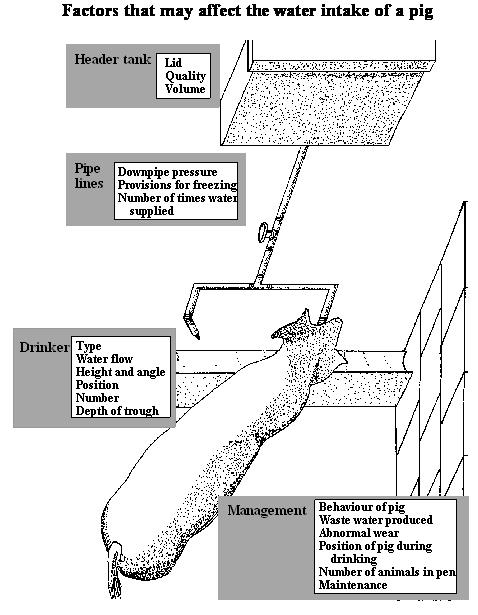
waste. There are a number of features,
illustrated in figure 1, to bear in mind.
Three specific points to note: a)
The flow of water through
the drinker. From a nipple or bite drinker provide 2 litres per minute (minimum 1.5
litres per minute). This means that dry sows obtain their daily water intake
in 6 minutes and a lacating sow takes 20 - 30 minutes. How long do you drink each day? Research has shown that weaners may only
spend 3-4 |
|
|
minutes drinking each day. In a trough scenario a sow will drink 3
litres in 45 seconds. b)
Height of the drinker. For
sows a nipple or bite drinker should be placed at 75-90 cm from the
floor. Note the drinker needs to be
easily accessible and not shielded or hidden by other equipment. c)
Drinkers should be 2
metres apart in loose housed sows to prevent one sow dominating the drinking
system. |
|
How can water specifically affect reproduction?
There
are four specific conditions to consider.
a)
Cystitis and pyelonphritis
b)
Gilt vaginal and vulva
mucosal sloughing
c)
Poor wate quality
d)
Lactation feed intake
e)
Water for body temperature
control
Cystitis and Pyelonephritis
Cystitis
is infection of the bladder and when it damages the ureterovesical valves,
infection ascends to the kidneys resulting in pyelonephritis.
The agents isolated from
cases are primarily bacterial, associated with Actinobaculum (Eubacterium,) suis, Escherichia coli (E. coli) and streptococci.
All of these are very common either in the environment or in the prepuce
of the boar. The disease occurs when the
defence mechanisms of the bladder is affected. The defence mechanism of the
bladder is primarily influenced by poor urination. Water availability has an impact on the sow's
urinating patterns. Because this disease
is a combination of poor enviroment and behaviour, the disease is seen in adult
sows, particularly those older than parity 3.
The clinical signs depend
on if the bladder only is affected or where there is damage to the kidneys as
well. If the bladder only is affected
(cystitis), the clinical signs can be minimal with only the production of
smokey urine, some pain response and frequent urination, many of these signs
the average stockperson will miss. Note
some 70-90% of sows in the farrowing house may have histological evidence of
cystitis.
|
Once the disease affects
the kidneys the clinical signs can be dramatic and sudden. In acute pyelonephritis cases the sow will
be a few days post-breeding. She may
appear to be urinating frank blood, off food, collapsed, hypothermic or may
be found dead. Death can occur with
hours of any presenting signs.
Recovery is unlikely.
Alternatively the sow may have chronic pyelonephritis, which can occur
at any time in her reproductive cycle.
She will be urinating smoky to red/blood urine. The sow will be toxic and this creates
rapid breathing, off food, weakness in hind legs, collapse and death. The major affect on
reproduction is death of the pregnant sow.
Majority of sow's with pyelonephritis will be
pregnant and therefore the farrowing rate is reduced, on specific farms this
has accounted for a 10% reduction in the farrowing rate. There may also be some reduction in litter
size associated with excessive toxins which have not been cleared from the |
Figure 2 Kidney with chronic pyelonephritis - the
white/grey areas, the darker areas are still functioning kidney
|
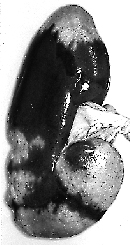
body by the affected kidneys,
but this is only apparent in severe chronic cases.
Treatment routines
Individual sows
Loose house the sow
and provide exercise (forced if necessary) to encourage urination. Provide continuous access to troughed
water. Use of antibiotics such as a
combination of lincocin and tetracycline by intramuscular injections can be
very useful. Note in acute cases the sow
can die very rapidly.
Herd treatment
Water and urination
It is essential to
encourage regular and frequent urination.
During the problem period check all sow's post-service (0-28 days) for
any blood in her urine. Treatment is
more effective when a case if descovered early.
Ideally feed or heat check the sows twice daily
to encourage the sow's to rise and urinate in the afternoon.
Improve water availability
to provide water at a flow rate of 2+ litres per minute. One way to check if the water supply is
adequate, is to enquire about the average sow feed consumption on day 18 of
lactation, which should be approaching 10 kg per day. Regularly maintain water supplies and record
that the examination has been carried out.
Farrowing house management
Limit any trauma and infection of the
vagina and bladder, improve hygiene behind the sow by
manually removing faeces 3 days prior and 7 days post-farrowing. Very dirty rear regions should be cleaned
with soap and water. Reduce manual
farrowing as much as possible, and if it is necessary use plastic gloves and
clean hands. All sows manually farrowed
should receive appropriate antibiotics.
Encourage the correct use of oxytocin where appropriate. Ideally increase lactating length to 24 days
to allow for any damage to the bladder and vagina, which occurred at farrowing,
to heal by the time the sow is rebred.
Breeding area hygiene
At all times stalled
sows must be separated for her urine and faeces. Clean all soiled rears of the sow
particularly prior to service. Avoid
contact with the boar's penis during service.
Ensure that the underline of the boar is kept clean by managing the boar
in a clean dry environment. Ensure
service is carried out on a good non-slip floor. Do not serve lame sows with boars, only use
AI.
Gilt vagina and vulval
mucosal sloughing
Puruent vulval dischages and
water availability has been difficult to associate. Majority of 14-21 day vulval discharges,
which result in failure of pregnancy, are associated with breeding management
rather than specific water issues.
However, cases of vulval discharge in gilts (bred and unbred) have been
seen which are associated with farrowing rates below 60%. The characteristic of these animals were that
they were subjected to long distance transportation without water and then were
bred within 10 days of arrival on to the farm.
The transportation distances varied, but in three cases they were 1500
miles over land. The animals presented
clinically weak, dehydrated but otherwise fit.
Examination of their external genitalia revealed swelling, congestion
and sloughing of the internal mucosa of the vulva and vagina. The lining of the vulva and vagina were very
dry and no natural lubrication could be elicited. The genital injuries healed within 2 weeks of
arrival following normal care. However,
of the gilts which were bred within 10 days of arrival, 20% presented with a
very purulent vaginal discharge within 2-3 weeks of breeding, the farrowing
rate in the remaining was only 60% with a resultant poor litter size, however,
their genitalia recovered. Ceasation of
breeding immediately post-arrival restored the normal reproductive parameters
and changes in the transporation protocols, allowing time to stop and provide
water and allowing gilts the ability to urinate naturally, stopped the drying
of the vulval and vaginal mucosa.
Poor
water quality
This is a very poorly
documentated area. However, without
scientific proof, there are several cases where reproductive problems have
persisted over a long period of time (low farrowing rates -65% and low litter
size -10.5 live born) have suddenly been resolved by the use of municipal water
supplies as compared to the bore hole water previously used. No specific investigation
into the differences in water quality have been carried out or no
specific differences were noted, given the range of tests carried out. However, water quality is an area where
investigations are required and from time to time can make a significant
difference to the performance of the breeding sow.
Lactation feed intake
There
are many factors that can affect lacatation feed intake. Clinically there are three major areas which
should be examined first as they have the biggest impact (in my opinion): Water provision; farrowing house temperatures
(day and night) and the health of the sow.
Water
and lactation feed intake has received scant research. What research has been done has been
contraversial with several trials indicating little correlation between water
and feed intake. However, most trials
have used nipple or bite drinkers which automatically limit the sow's ability
to drink or fail to standardise the availability of water, merely stating
'water was freely available' which is little more than meaningless.
In
my own studies average sow lactation feed intake over a 24 day lactation has
progressed from 5 kg a day with a peak intake of 6-7 kg at day 18 through the
feeding of dry lactation feed (18% protein 1% lysine 14 MJ DE) to 6.8 kg a day
with a peak intake of 9-11 kg at day 18 using the same feed. Recent studies on liquid feeding (using a
very similar formulae for the feed on a per dry matter basis) has resulted in
increasing average lactation intakes to 8 kg a day with a peak intake of 11-14
kg on day 18. The weaning weights of the
piglets have closely matched the average lactation intake. With liquid feeding over
100 kg of piglet weaned have been achieved per sow per weaning. On all these farms no other change in
farrowing house design, genetics or basic stockmanship occurred. The impact on
reproduction has been more difficult to assess.
The farms where these results have been obtained are non-reseach farms
where many other parameters are changed or moulded over time to maintain
output. On all of the farms the
reproductive results were good to excellent, with farrowing rates 82% or above,
total born 12.5 or above, the number of piglets weaned being in excess of 10
per sow per litter. However, from time
to time, despite the lactation feeding regimes, reproductive performance also
failed, associated with, for example; bouts of poor health, stockmanship errors
or seasonal influences.
Water for body temperature regulation
The
pig is unable to regulate its body temperature through sweating, as sweat
glands are very localised in the pig, on the carpus
for example. Body temperature regulation
is primarily through behaviour and panting. In hot climates being able to avoid
the heat and humidity may be impossible, particularly with the development of
large pig farms utilising European genetic coupled with little provision for
the sow and boars to turn around.
Therefore the necessary microenvironment must be provided. Reseach again is sparse and a large reliance
on clinical observation is required.
General advice can be given and has proved to be sucessful in
practice.
Boars
The
boar is particularly sensitive to temperature effects on semen output and
quality, with a marked decrease in output and an increase in abnormal sperms
been seen in the hotter weather. Of interest is how the semen quality will vary
over the day with reasonable quality sperm being obtained in the cool morning
and very poor quality sperm being obtained in the heat of the mid-afternoon. Boars
subjected to an ambient temperature of 30C for 2 days can have poor semen
output for the next 6 weeks and some of the animals do not recover from the
heat stress.
Sows
|
Lactating
and pregnant sows will reduce their feed intake (depending on feeding
routines) if they are subjected to heat stress. This will result in loss of maternal
bodyweight and in lactation a reduction in litter weaning weights. The effect on reproduction is more
difficult to analyse as the effects can be transient. However, effects of loosing weight in
lactation can extend the sow's weaning to breeding time, which has negative
reproductive consequences. |
|
|
If
pregnant sows are sufficiently temperature stressed they can abort. However, note that this can be associated
with excessive heat stress, but also poorly cooled sows which are damp and
subjected to excessive air movement can result in too much cooling, the
chilling will result in abortion. In
outdoor systems, even in temporate climates, adequate cooling provision
through mud wallows are essential to assist in reaching acceptable
reproductive performance. |
|
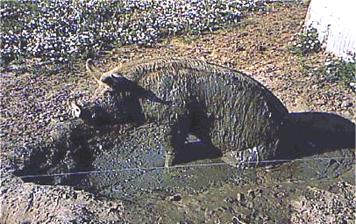 Outdoor sow enjoing a mud wallow
Summary
Water
is an integral part of the sow's requirement for survival and yet is often
overlooked in the normal daily routines.
Water plays many roles in the sow and in the specific case of
reproductive performance if clear drinking water is not provided in sufficient
qaulities can specifically influence
a) production
through the death of the pregnant sow with pyelonephritis,
b) interfer with the gilt's ability to breed though changes in
the vaginal and vulval mucosal integrity,
d)
affect lactation feed
intake,
e)
affect boar semen production
and sow mating abilities through lack of cooling and
f)
in an undefined way affect reproduction in general through poor water
quality.