Batch Farrowing Place
Not all sows and gilts are equal
The Real-Time Batch Breeding Target
Ensuring that the correct breeding target is set is more complicated than just looking at the "historical" farrowing rate %. A batch breeding target should be calculated in real time. This can be achieved by understanding the chance of farrowing success for all of the different parties.
Who are the parties that make up this batch breeding pool
Gilts, weaned sows and return sows.
What factors influence the farrowing rate % of these females?
Factors that can affect the farrowing rate % was investigated in America and Australian pigs. Paper.
Season
The seasons play an enormous role in the likely farrowing rate % and this is discussed in a separate paper. The affect appears to be on all of the females - sows and gilts.
Gilts
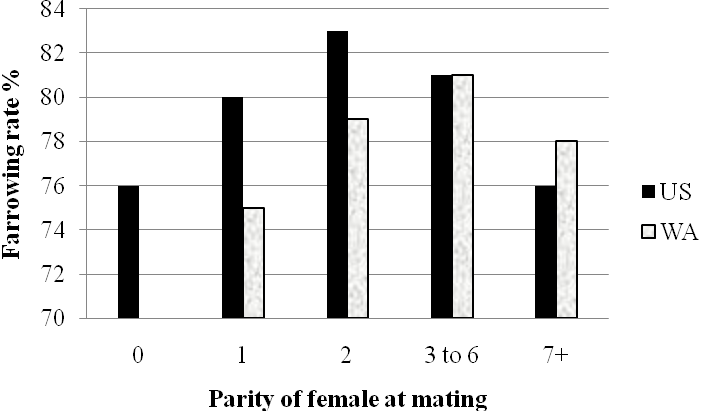
The influence of parity on the farrowing rate
The gilt has a reduced farrowing rate. Also the older sow but there should be less of these animals in the herd.
Sows
The weaned sow
What is the influence of lactation length on the farrowing rate?
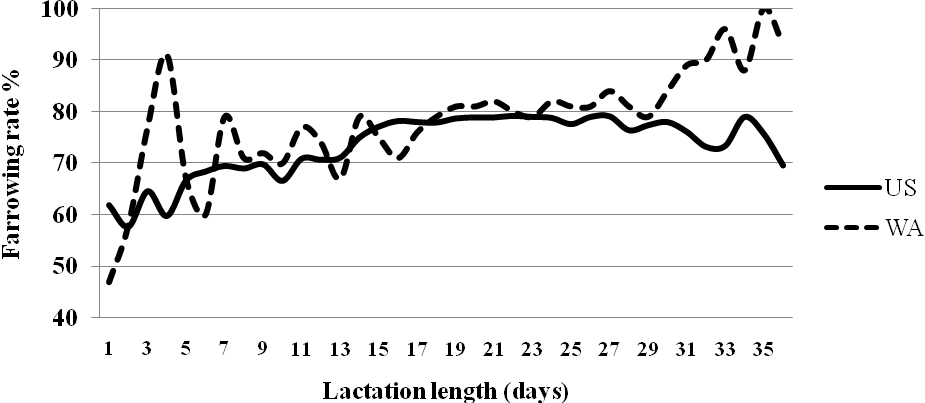
With weaned sows the there is minimal influence on the future farrowing rate % if the lactation length is longer than 15 days. Before day 15 there is a progressive loss of farrowing rate.
What is the influence of the wean to service interval?
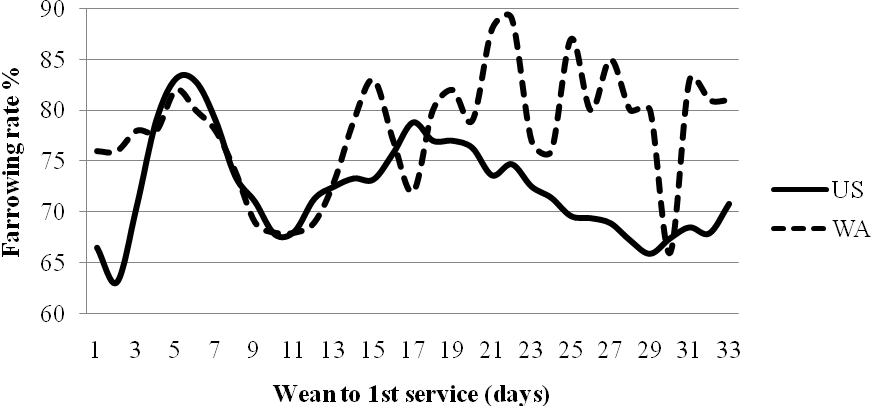
There is a significant relationship between the wean to service interval and the future farrowing rate.
If the wean to service interval is shorter than 3 days or longer than 7 days the farrowing rate is reduced.
Return sows
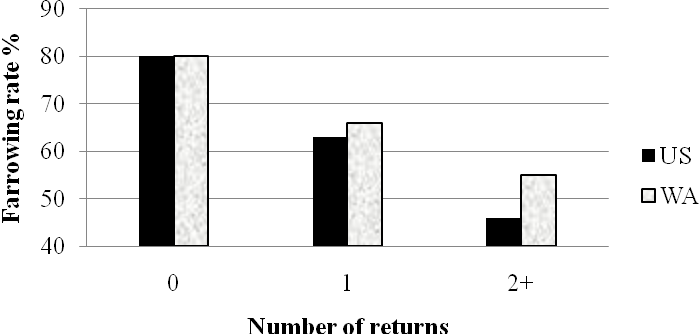
There is a significant reduction in farrowing rate each time the sow or gilt returns to service.
Real-time batch breeding target
Gather information about your own sows - look at your own data.
This can enable the farm to predict a real-time breeding target. This initial calculation should be performed on the day of weaning - when the farm knows the number of weaned sows (going to be retained - ideally all of them) and the number of gilts likely to cycle over the next 7 days (Those that were seen and marked cycling 3 weeks ago) The returns should be the only "surprises".
Then a simple spreadsheet can be used to predict and then monitor events over the batch breeding period.
The calculation:
Rounded down to whole female ((Expected number to farrow for each category)*influence of season)
In the default, we clearly see that if the farm had adopted a normal approach, assumed that the farm had a farrowing rate of 82% then as long as 25 females are mated this should be sufficient:
Wrong.
Because only 19 out of the 20 sows in lactation were going to be presented to the breeding pool, the influence of the five gilts with only a 75% farrowing rate and the single return with only a 60% farrowing rate, this reduced the effective farrowing rate % to 76% - thus requiring at least one other female to be mated to have a reasonable chance all the farrowing places are filled.
The net effect of failing to meet the real-time batch breeding target - an empty farrowing place - increased cost of production.
The major mistake the farmer made was to fail to have sufficient gilts available to cover the lack of weaned sows. This is a common mistake. But this could have been easily avoided by planning. It is likely that the missing sow was recognised weeks ago.
This area will be covered in gilt management.