Management of a
Crated or Tethered Gestating Sow
In these environments, the pig has no control over its environment. The stockperson must provide for all of the pig’s requirements. If the stockperson cannot achieve this, alternative systems must be adopted.
|
Daily provision |
|
|
Length of the stall Ensure daily that the stall or resting area of a tethered sow is long enough for the sow or gilt. It is not acceptable to tie the end gate open or have the sow backend over the edge of the lying area. If the sow appears too long she must be moved immediately |
|
|
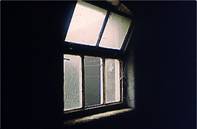
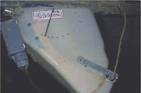
No drafts The sow cannot move away from any undesirable air movements. The stockperson is duty bound to remove all drafts immediately. Abortions are likely when sows are housed in a draft. The photograph shows a broken window – not fixed for 4 weeks. |
|
|
Ambient air temperature – cooling
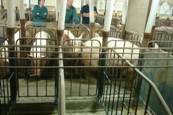
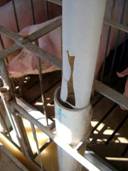
and heating The sow cannot find an environment that is comfortable. It is essential that the stockperson provide air temperatures, which are acceptable. A sow is heat stressed above 18C. One way to check that the sows are comfortable is to quietly enter the gestation house in the mid afternoon and look at the sows – some 95% should be lying on their sides. The photograph shows an evaporative cooling system, which is not working 100%. |
|
|
Encourage the sow to rise Sows should be encouraged to rise at least twice a day. Walking the boar in the afternoon to heat check will encourage sows to rise, urinate and defecate. This is essential for good health. |
|
|
Examine the sow daily Look for signs of lameness, injury, sore feet or legs, swellings or granuloma. Any animals found to be sick or injured needs attention, which may involve removing the sow to a hospital area. |
|
|
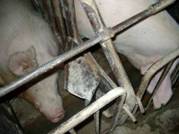
Water supplies Ensure that every sow has adequate water supplies. This includes both access to a drinker or trough, but depth and flow of water. The photograph shows a drinker that was difficult for the sow to approach. The drinker has been broken and was badly fixed. |
|
|
Feed supplies Ensure that the sow receives her daily feed requirements. Ensure that there is no mold in the feed provided. It may be necessary to provide fibrous material in the afternoon to reduce boredom. Manage the feeders to reduce waste feed. |
|
|
Reproductive status Daily every gestation sow should be checked for signs of oestrus and for possible abortion. Heat checking with the boar once a day greatly helps this observation |
|
|
Twice a week |
|
|
Check tethers At least twice a week check the tethers and adjust as necessary |
|
|
Every two weeks |
|
|
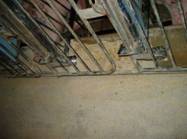
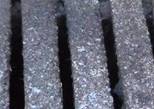
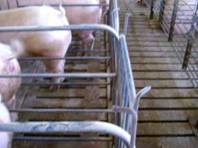
Check the floor’s integrity Examine each floor area every two weeks. Remove sows living on inadequate flooring and repair or replace the broken/worn flooring. The photograph shows totally unacceptable slats. |
|
|
Body score sows Body score every sow and adjust the feed availability appropriately. There are methods of trickle feeding sows within stalls to help control stealing and bullying from other sows. |
|
|
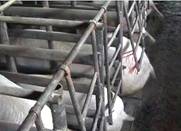
Metal work Check the integrity of all metalwork that the sow has access too. If the crate or stall has sharp areas, remove the sow and repair the stall. It is not acceptable to see sow’s with skin injuries from rough paintwork. |
|
|
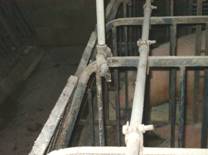
Feed pipes Check all the feed pipes to ensure at no food is being wasted through cracks or gaps. Ensure that the feed pipe ends are not sharp or rough which may injure the sow |
|
|
Light Check that all the lights work and the light intensity is appropriate. Replace all broken lights and clean dirty lamps. Gilts in the breeding area require 500 lux of light, 16 hours on and 8 hours off to maximize breeding and oestrus. |
|
|
Monthly |
|
|
Review sow movements It is imperative that sows and gilts are not moved between days 3 and 28 after breeding. |
|
|
Pregnancy diagnosis accuracy Ensure that the pig flow is accurate and that all pregnancy diagnosis machines are working and accepted protocols are being followed. |
|
|
Yearly |
|
|
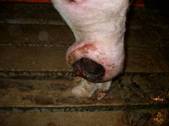
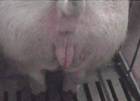
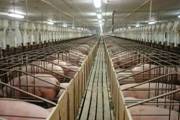
Overall examination of the whole house This particular photograph shows a stall house where the floor was placed wrong with the solid part of the floor under the sow’s vulva and Vulval discharges were created because of this poor layout. |
|

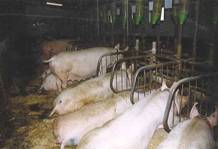
Stalls, crates and tethers are perfectly acceptable alternatives
to other gestation housing systems, when the animals are provided with good stockmanship.
However, with inadequate, poorly trained, poor or inconsiderate
stockmanship, the system is extremely unforgiving to the animal.
Canadian advice indicate that a minimum of 10% of the
stalls should be 70 cm wide, 30% 65 cm wide and no more than 15% be 55 cm wide.