What stops me achieving an 85% farrowing
rate?
Any sow or gilt which has a questionable reproductive history should be
mated by the most experienced breeder on the farm
|
Season |
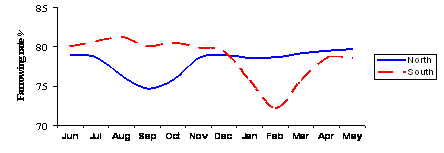
Summer infertility occurs on
most farms to some degree. The
farrowing rate drop can drop by 5-15% depending on the farm. Analysis of records will provide a history
of previous seasonal effects. A summer
with variable high temperatures appears to have greatest reproductive
problems. The graph below shows results for the northern and southern
hemispheres ( |
|||
|
Month of breeding |
||||
|
Repeats |
The number of repeats has a significant negative effect on farrowing rate. As the sow or gilt repeats her next farrowing rate drops precipitously. All gilts which repeat should be mated by a boar at least once. |
Repeat |
Farrowing rate |
|
|
0 |
82% |
|||
|
1 |
70% |
|||
|
2 |
60% |
|||
|
3 |
40% |
|||
|
4 |
25% |
|||
|
Discharges |
Sow/gilt repeats at 14-21 days post-mating. The primary cause is mating late and the introduction of bacteria into a defenceless uterus. |
|||
|
Gilts |
Gilts in general only have a 75% farrowing rate. |
|||
|
Heat number |
As the gilt matures the farrowing rate and litter size increases. |
|||
|
Feeding post mating |
Feeding too much energy post-mating will reduce the farrowing rate. Limit the gilt to 2kg a day 14MJ diet for 14 days post-mating. |
|||
|
Poor acclimatisation |
If the gilt is not acclimatized properly she will be more susceptible to the effects of pathogens – particularly viruses. PRRSv, SIV and erysipelas would be examples. |
|||
|
Return gilt |
Any gilt that has a return should be mated with the most experienced breeder and ideally by a boar. It is essential to get the gilt pregnant to minimize parity loss. |
|||
|
Lactation length |
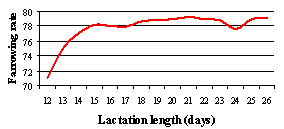
As the lactation length increases to 17 days the subsequent farrowing rate increases. Increasing lactation length may increase the number of sows which demonstrate an oestrus during lactation. |
|
||
|
Wean to service interval |
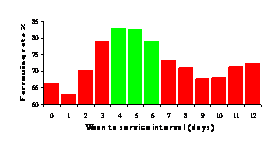
It is essential to mate during the period 4-6 days post-weaning. If mating 2 days or between 7 and 14 days post-weaning the farrowing rate falls precipitously. However, it is essential that the sow is in oestrus when mated. |
|
||
|
Sow age |
The
gilt has a lower farrowing rate of sows at 75%. The
farrowing rate decreases again after parity 6, falling below 80%. Note
the parity structure of the herd.
Limit parity 7+ to less than 8%. |
|||
|
Semen flow |
Monitor
boar fertility – including AI boars.
Cull all boars with a farrowing rate < 75%. |
|||
|
Semen age |
Note
semen age – ideally use before day 3 post-collection |
|||
|
Semen storage |
AI
semen must be stored between 15 and 20°C – ideally around 17°C. Monitor
the temperature fluctuations. Note if
too many semen doses are taken to the mating barn. |
|||
|
Semen handling |
Ensure
the AI mating is carried out cleanly.
Only mate sows and gilts that are in heat. Do not leave the catheter in more than 10
minutes after mating. |
|||
|
Boar housing |
Boars
will go sub-infertile if the temperature is above 30°C for any length of time – 2 days. Monitor the temperature of the boar’s
accommodation. Note that any
infertility can last 6 weeks or more. |
|||
|
Abortions |
The
majority of abortions are difficult to pin point or assign a cause. However,
pathogens may be controlled by gilt introduction and acclimatization
programmes. Environmental
causes should be avoided – draughts and variable temperatures. Avoid
feed related causes - mycotoxins |
|||
|
Movement |
Avoid
moving the sow/gilt from day 3 to day 24 post-mating. |
|||
|
Mixing |
Avoid
mixing the sow/gilt from day 3 to day 24 of pregnancy and always mix in the
evening and start the feed cycle. Use scents to minimize fighting. |
|||
|
Culls |
It
is essential to properly ascribe the cause of the failure to farrow. Too many sows are “culled” on the records
and the real cause is not defined.
This only causes chaos. |
|||
|
Non- reproductive |
It
is imperative to minimize the sows culled for non-reproductive reasons. This must be done before the final pig flow
decisions have been made. Review
all sows in the mating pool for conformation issues – body condition, leg
structure and mammary gland observations.
Sows which are unsuitable for mating should have been determined 6
weeks prior to the previous farrowing. |
|||
|
Reproductive |
Only
cull pregnant animals as part of the pig flow model with culling at pregnancy
checking. These culled pregnant sows
should be removed from the farrowing rate calculation. They were mated to improve their feed conversion
efficiency, improve their sale value and provide insurance against a
potentially empty farrowing crate. |
|||
|
Deaths |
It
is vital to eliminate cystitis and pyelonephritis deaths. These are all associated with poor water
supplies in gestation or the previous lactation. |
|||
|
People |
||||
|
Breeding routines |
Ensure
that sows in heat which are skipped until the next day actually get
pregnant. This is classically day 4
post-weaning animals. Note there is
little difference in the farrowing rate between 4 and 5 days post-weaning. |
|||
|
Pig Flow |
Ensure
breeding targets are set and met. |
|||
|
Multiple matings |
Review
mating programmes ensuring that sows and gilts are mated twice. Three times mating often demonstrate a
higher farrowing rate, but this may be only a feature of the
wean to service intervals.
Sows with short wean to service intervals stand longer and are more
fertile. Two matings should be
sufficient to achieve pregnancy. |
|||
|
Oestrus behaviour |
Well
trained stockpeople will recognized the signs of oestrus. Gilts may demonstrate good signs of oestrus
but it may be short. In sows the signs
of oestrus may be more subtle. In
large herds separating heat checking from mating has improved the farrowing
rate. |
|||
|
People |
Not
everyone is suited for heat detection and mating protocols. |
|||
|
Examine
the use of breeding aids such as belts and weights. |
||||
|
Post-mating behaviour |
Ensure
that the sow or gilt is provided with a gentle environment in the immediate
5-10 minutes post-mating. This allows
the semen to be transported within the uterus to the oviducts. |
|||
|
Pregnancy checking |
It
is essential to recognize the none pregnant animal
as soon as possible. The most
effective pregnancy checking machine is the boar. Detecting an open sow in week 16 of
“gestation” is not adequate |
|||
The
difference between conception rate and farrowing rate should be less than 3%
The following is an embedded excel spreadsheet which can be utilized to demonstrate the
discussion above.
