Pneumonic Pasteurellosis and Streptococci
Causal agent
|
Pasteurella
multocida and various species of streptococci, typically Strep.
suis. Both are bacteria. Note toxigenic forms of P. multocida are associated with
Infectious Progressive Atrophic Rhinitis. |
|
|
Age group |
Clinically
affects the growing and finishing pig |
|
Clinical signs
|
||
|
|
Generally
represents the final stage of the post-weaning respiratory syndrome |
|
|
Acute form |
This
is most commonly associated with P.
multocida serotype B. The animal
presents with dyspnoea, laboured breathing, thumping, high fever 42.2•C
(108•F) prostration and finally death.
Purple discoloration of the abdomen is not uncommon. |
|
|
Subacute |
Pleuritis,
coughing, difficulty in breathing. In
chronic cases the pig can lose a lot of weight. The pigs may have only poor or no growth
with serious consequences in pig flow. |
|
|
Chronic |
Occasional
cough, thumping and little or no fever.
Generally affects pigs from 10-16 weeks of age (25-50 kg) |
|
|
|
|
|
|
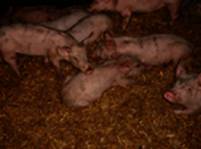
A
pig with chronic pneumonia, where pasteurella and streptococci were playing a
role in killing the pig. |
Nearly
all of these pigs will be carrying pasteurella and streptococci in their
noses. |
|
Infectivity
|
||
|
|
Piglets
are infected with streptococci from the sow within hours of birth, some may
be infected intrauterine. Pasteurella
may be acquired within 5 days of birth. |
|
|
The
bacteria are very common and probably a normal inhabitant of the pig's nasal
flora |
||
|
Nose
to nose contact most common route of infection |
||
|
Aerosol
infection is possible. |
||
|
Rodents
may carry or transmit pasteurella |
||
|
The
disease may be spread around the body via the blood stream after tail biting
or feet damage. |
||
Stress factors
|
||
|
|
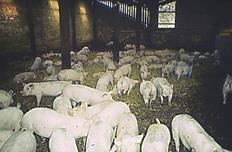
All
the normal stress factors involved in the post-weaning respiratory complex
with draughts, chilling, damp environment, overstocking, mixed age groups and
moving pigs are classic stressors. |
|
Incubation period
|
||
|
|
The
disease can be very quick as the organisms may be already established in the
pig. |
|
Post-mortem
Lesions
|
||
|
|
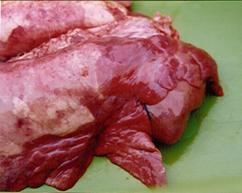
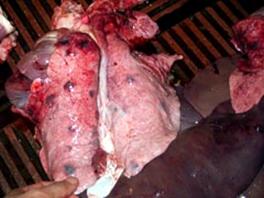
Generally
part of the enzootic pneumonia complex with and superimposed on, the lesions
resulting in cranial consolidation.
Severe cases may also present with pleurisy and abscessation. Note pasteurellosis in association with
other viral agents in particular PRRSv or Swine Influenza virus can produce
lesions closely resembling Mycoplasma
hyopneumoniae (Enzootic pneumonia) even on M. hyopneumoniae
negative herds. Note similar lesions
may also occur associated with lower water availability and high ammonia
concentrations. Also note any foot
lesions or evidence of vice where haematogenous spread may occur. |
|
|
Post-mortem findings |
|
|
|
Pasteurella
and streptococci are commonly isolated from cases of enzootic
pneumonia |
Streptococci
are commonly associated with pulmonary abscessation |
|
Diagnosis
|
||
|
|
Isolation
of the organism. Note this can be
complicated by the fact that both pasteurella and streptococci are very
common in the respiratory tract. Also
isolation can be complicated by concurrent antibiotic therapies. The isolation of pasteurella and
streptococci does not mean they were the causes of the problem. However, they
would have been significant in the animal's death. |
|
Treatment
|
||
|
Individual |
Antimicrobial
agents, however, combinations are often required as the pathogens are rarely
a primary agents and may be multiple types |
|
|
Vaccination
against Mycoplasma hyopneumoniae
has significantly reduced the effects of pasteurellosis. |
||
|
Control |
All-in/all-out |
|
|
Ventilation
– avoid draughts and high ammonia concentrations |
||
|
Avoidance
of temperature fluctuations |
||
|
Stocking
rate controls |
||
|
Reducing
other causes of pneumonia and other respiratory conditions |
||
|
Minimal
mixing and sorting |
||
|
Reducing
building and pen size |
||
|
Enhance
drinking water supplies |
||
|
Vaccination |
Generally
disappointing |
|
Common
differentials
|
||
|
|
Actinobacillus
pleuropneumonia, Salmonella
choleraesuis. Enzootic
pneumonia. Most other respiratory
diseases. Water limitations and high
ammonia concentrations. Note foot
lesions and vices. |
|
|
Zoonotic implications |
||
|
|
None
specifically, although both Pasteurella spp. and streptococci spp. may be
pathogenic to man |
|